Before the Employment Contract: The Rise of Written Work Agreements
Written work agreements took different forms across history. Learn what records could preserve, whose interests they served, and how to read modern terms clearly.
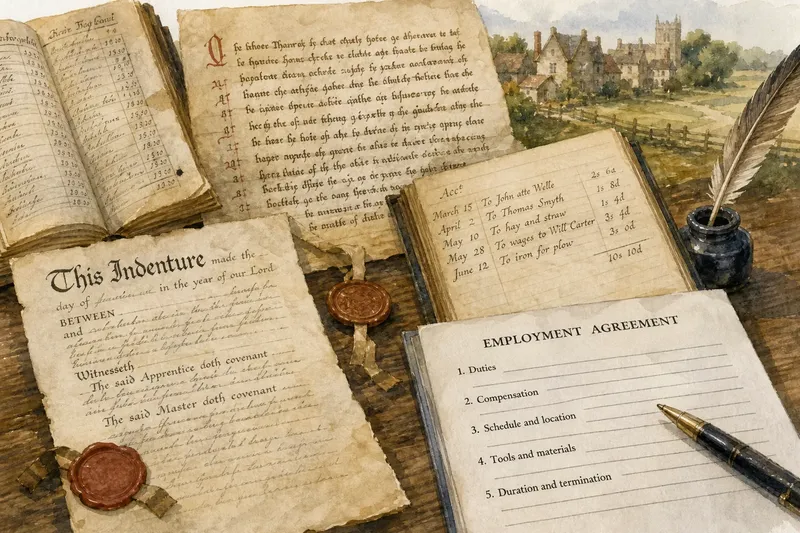
The common mistake in tracing written work agreements is to imagine a single moment when paper replaced spoken promises. A medieval English manor record, an apprenticeship indenture, and a modern employment contract arose in different settings and served different purposes. Writing could preserve obligations, but it did not automatically give workers control over the terms.
Work before contracts
Work was organized long before the familiar employment contract. In many communities, duties and compensation rested on custom, household authority, or repeated practice. A farm worker might understand an arrangement through seasonal tasks and lodging; a craft apprentice might be bound by a relationship involving training and service.
These arrangements were not necessarily rule-free. Their terms could be carried in memory, witnessed conversation, or local practice rather than in a document made for each worker. If a dispute arose, the parties might describe the custom differently, leaving an outsider unsure what had been promised.
The important distinction is not between work with rules and work without them. It is between rules preserved in people and practice, and rules set down in a record.
Manor records
For medieval England, surviving manorial materials include records such as court rolls and accounts. Their contents and uses varied, but they were part of managing estates and documenting matters handled by the manor. They should not be mistaken for modern employment contracts or for a negotiated copy of every worker’s terms.
A record about labor could preserve information useful to an institution without giving a worker a document to consult or a voice in its wording. The existence of a record tells us that someone considered the information worth preserving; it does not, by itself, establish that both parties agreed to the text.
Ask who kept a record and why before treating it as evidence of a worker’s own agreement.
Apprenticeship writings
In early modern England, apprenticeship arrangements could be recorded in formal indentures. Such documents described a relationship in which a master undertook obligations associated with training while an apprentice owed service. The arrangement was not the same as a modern job offer, and its terms reflected the period’s household and occupational authority.
Written apprenticeship terms could make duties more legible to people beyond the original conversation. But a document’s formality did not mean that the parties had equal power to shape it. Nor does the existence of an indenture tell us whether every worker in a town or trade had a comparable record.
Written forms appeared in particular relationships and institutions; they did not spread as one universal model.
Accounts and payment
Work-related writing also took less formal shapes. An account book might record payments or goods supplied; a note might identify a debt or task. These records could help a household, business, or authority remember transactions without setting out a complete agreement between employer and worker.
A payment entry may indicate that money changed hands, but it may not explain the hours, duties, or future expectations the parties discussed. A record is evidence of what its author chose to preserve, not a complete transcript of a working relationship.
Read the type of record as carefully as its words.
Printing and administration
As businesses and public institutions developed administrative practices, written records could help manage staffing, wages, and obligations. The forms and timing differed by place and occupation; there was no single path from a handwritten note to the standardized employment paperwork familiar today.
Printed forms and office procedures could make records easier to reproduce and handle. They could also leave little room for an individual worker to alter the wording. A document might support consistent recordkeeping while reflecting the priorities of the employer or institution that issued it.
Standard wording can make terms easier to compare, but it does not reveal who had the power to set them.
What records can prove?
Did written agreements replace spoken promises?
No. Written records and spoken understandings could exist side by side, and some arrangements continued to depend on custom or conversation. A document preserved some terms without capturing every expectation.
Was every work record a contract?
No. A ledger, account, court record, or payment note might document part of a working relationship without setting out a complete agreement. Its purpose and author help determine what it can tell us.
Did writing give workers more power?
Not automatically. A record could make obligations visible, yet an employer, clerk, or institution might control its wording and keep the only copy. Access and authority mattered alongside the fact of writing.
How should modern documents be read?
Compare the written terms with the actual duties, compensation, schedule, location, supplies, and process for changes. For unclear terms that may affect legal rights or obligations, seek advice from a qualified local professional.
Reading today’s agreements
The history offers context, not a template for drafting a current contract. Present-day rights depend on local law and the nature of the working relationship. Still, one question remains useful: whose understanding does the document preserve, and what does it leave out?
- Duties: Check whether the tasks match the arrangement discussed. If they do, keep the description; if they do not, ask for revised wording before deciding whether to accept.
- Compensation: Check the amount or calculation method and when payment is due. If either is unclear, ask for an explanation in writing; if the explanation remains incomplete, decide whether to proceed with that uncertainty or pause.
- Schedule and location: Check the expected hours, workdays, and place. If flexibility is undefined, ask which changes need agreement; if no process is offered, decide whether the uncertainty fits your circumstances or seek clarification before proceeding.
- Tools and materials: Check who supplies equipment and consumables. If responsibility is missing, ask for it to be assigned; if it remains unclear, decide whether you can accept the arrangement without knowing what you must provide.
- Duration: Check whether the work is ongoing, seasonal, or tied to a task. If no end or continuation term appears, ask how the arrangement may end or continue; if the answer is absent, decide whether to pause or accept that uncertainty.
- Changes and concerns: Check how changes and problems will be recorded. If no process is stated, request a simple written method such as email confirmation; if one is declined, decide whether you can accept having no agreed record of changes.
Say you are considering an invented typesetting job at a small print shop. The draft names the shop as the location, lists order preparation as a duty, says the shop supplies paper, and describes pay as a fixed amount for each completed order; it does not say who supplies press-cleaning materials or whether extra duties can be added. You compare the listed duty with the conversation, ask the owner to name who supplies the cleaning materials, and request wording that any added duties require agreement. If the revised draft names the shop as the supplier and includes that agreement process, the observable result is a document that answers both questions; you can then decide whether the stated pay and duties suit you. If the owner declines, the draft still leaves the materials and added-work terms unresolved, so you can weigh those open points or seek local professional advice before deciding.
The history of written work agreements was not a clean passage from speech to paper. Manor records, apprenticeship writings, business accounts, and later administrative forms served different purposes, and none alone captures the full relationship behind the work. For written work agreements today, ask who created the record, what it leaves out, and whether the people expected to rely on it can understand and access it.
When a document and a conversation do not match, the gap identifies the term that still needs an answer.